
The quest for love & peace.
Superman first flew into our lives in Action Comics #1 in 1938. Created by Jerry Siegel and Joe Shuster. While not the first on-screen Superman, the Reeve’s era arguably remains one of the most memorable iterations of the character.
The first Superman came out and was an instant hit thanks in part to its groundbreaking special effects that lived up to the film’s tagline, “You’ll believe a man can fly” Without a doubt, the highest of high points of the entire series. The film was a commercial and critical success.
Superman I and II were shot back to back, with Richard Donner directing both, but despite having filmed a significant amount of the second film, Donner was fired and replaced by Richard Lester, who re-shot a lot of the footage; among other things, the money-saving decision was made to axe all Marlon Brando’s footage. Gene Hackman also refused to come back for any further reshoots or ADR; Hackman was joined in his solidarity with Donner by editor Stuart Baird and creative consultant Tom Mankiewicz, who also left the project. The whole thing is a tale for another time, but Donner’s vision of Superman II was eventually released in 2006, and is now widely considered the superior version.

Now under Richard Lester’s full control, Superman III leans further into comedy and is really more of a Richard Pryor comedy vehicle than it is a Superman movie. However, the third film still has some really good parts, such as when Superman fights the bad version of himself, perhaps the closest thing we got to Bizarro in the series.
The fourth entry, this time directed by Sidney J. Furie, saw the return of Gene Hackman as Lex Luthor and the full return of Margot Kidder as Lois Lane, whose appearance in the third film was more like a guest appearance. So the film on paper sounds like it would be a sure-fire classic.
However, the film was being made by the notorious Cannon Films, known for there cost cutting low budget filmmaking. With the reduced budget came cheaper effects and rehashed ideas. Though it broke even, the film was still a commercial and critical disappointment.

Christopher Reeve and Richard Donner
It’s amazing how big franchises like these can be so mismanaged; even today, lessons haven’t been learnt, such as with Disney’s mishandling of an ever-growing list of franchises.
A fifth film was proposed but discarded quickly after the poor performance of Quest for Peace. It wasn’t until 2006’s Superman Returns that the Man of Steel would see the big screen again.
Now with Brandon Routh donning the red cape, Returns was a half-reboot, half-continuation of the Reeves films. Superman Returns had, and still has, a mixed reception (personally I thought it was fairly good) but didn’t generate any sequels. It was another long gap before Man of Steel (2013), but now we’re getting away from the point.

The Scene
Lex Luthor’s nephew Lenny (Jon Cryer) is seen “playing” Gyromite on NES, with R.O.B (Robotic Operating Buddy). Another mildly interesting detail is that the NES is hooked up to the TV using an AV cable, not RF. Bad guys or not, the Luthor’s are getting superior video quality. Lex’s lair also has a few pinball machines and an arcade machine.
Along with what looks like some jukeboxes and a one-armed bandit (but they’re not games, so I don’t know why I mentioned them).
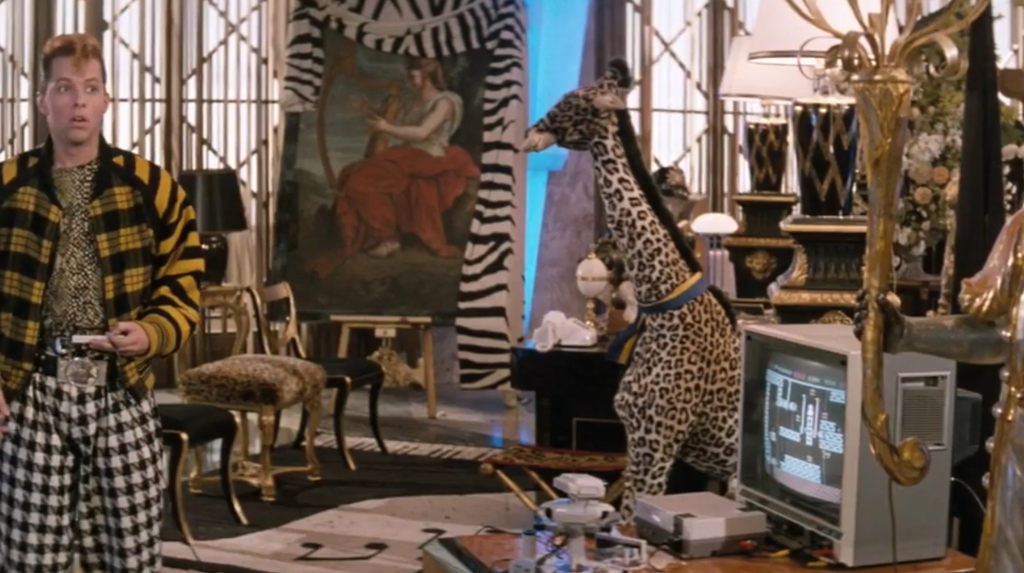

The Games on film this time are . . .
Nintendo Entertainment System (1985)
Nintendo’s first true home console, and the one that helped in part to revitalise the video game industry in America after the market crashed. NES introduced many franchises that defined the industry and are still going strong today, such as Super Mario, Mega Man, Castlevania and The Legend of Zelda, to name a few.
Gyromite, 1985, Nintendo (NES, Video Game) & R.O.B (Robotic Operating Buddy)
Gyromite was one of two games specifically made to work with R.O.B, the second being Stackup (85).
Gyromite, aka Robot Gyro. A puzzle game of sorts where R.O.B rises and lowers barriers so the player-controlled character, Professor Hector, can progress and collect dynamite before it explodes. Game B consists of the absentminded professor sleepwalking, so R.O.B opens barriers before the good prof. can walk into them.
R.O.B was a curious device that was perhaps a little too ambitious for its time. Brainchild of Gunpei Yokoi. The little robot acts like a quasi-second player. Though it can’t operate on its own, the player uses the standard NES controller to input the desired movement via the game; R.O.B then receives the information from the TV in a series of flashes that it can then interpret (somehow) into movement.
R.O.B used Gyros (spinning tops) to press buttons on a standard NES controller, whitch it’s self was held in a vice of sorts. A Gyro spinner was used to simulate longer button presses.
Impressively, R.O.B is wireless and runs on 4 AA batteries, with one additional D cell for the Gyro spinner.
A nice idea, but R.O.B’s movement is too slow to really be practical. The games themselves are fairly decent puzzlers.
Although support for R.O.B on the NES was short-lived, the character has continued to make cameos in various Nintendo games throughout the years, such as F-Zero GX (NGC, 03) and as a playable character in Mario Kart DS (DS,05) and has appeared in Super Smash Bros series as a fighter since SSB Brawl (Wii,08) More recently, R.O.B appears in The Super Mario Galaxy Movie (25).


Black Knight, 1980, Williams Electronics (Pinball)
Designed by Steve Ritchie, Software by Larry DeMar, Art by Tony Ramunni, Sound by John Kotlarik.
This machine saw several re-releases
Black Knight (Original release, 1980)
Black Knight (Limited Edition, 1981, not so much a different version of the game as a re-release of the original.)
Black Knight 2000 (1989, A slightly reimagined version of the original, with more features.)
Also memorable for its magnetic ball save.
Vector, 1982, Bally Manufacturing Co. (Pinball)
Designed by Greg Kmiec, Software by Rehman Merchant, Art by Greg Freres.
Vector was a design/content rich game. Notable for its use of voice, most of which went unused in the actual machine.
Part of the game’s design philosophy, according to Greg Freres, was to combat the growing popularity of video game arcades.


Unknown arcade
There is also some sort of video arcade between the pinball machines. It’s difficult to tell just what it is; however, the woodgrain, smaller size and no marquee lead me to think this machine is the EU/UK version of a game. Shares similarities to the machines seen in Never Say Never Again (GOF #27), which used arcade machines from Atari’s factory in Ireland.
It appears to have one central joystick, so this does narrow it down somewhat, bearing similarity to machines like Frogger and those, though they don’t match exactly.
At the moment I’m just not able to figure out what machine this is. Stay tuned for updates.
Mini Review
NES, R.O.B and Gaming in 1987
R.O.B launched alongside the NES when it debuted in America.
The supposed idea behind R.O.B was to use it sort of like a Trojan Horse. After the North American video game crash of 1983, the market was unsure of any new video game systems.
At CES 1984 (Consumer Electronics Show), Nintendo unveiled there preposed new video game system, AVS (Advanced Video System), which had more of a typical keyboard computer design. This traditional computer design didn’t gain much traction with prospective buyers.
Nintendo took note. The new design looked less like a computer or any other previous video game system, and more like a VCR; even the new name Nintendo Entertainment System separated it from the idea of video games.

Along with the improved rebrand came R.O.B, the cute robot accessory, which strengthened the impression of the NES being a toy. This may just have been surface level; behind the scenes, Nintendo had paid close attention to the mistakes made by Atari.
For instance, Nintendo had a tight fist when it came to licensing, only allowing third-party developers to make up to 5 games per year. This approach, in theory, would limit the amount of fly-by-night developers from releasing their half-baked ideas on the NES. This worked somewhat; however, companies wanted to release more than the allotted 5 game maximum. The result was that companies made subsidiaries to get around the limit. Such as Konami’s Ultra Games. Even with this quality control in place, bad games still surfaced; just look at the LJN catalogue.
Following a successful launch in North America, Nintendo’s 87 continued strong with the launch of many hit titles including . . .
The Legend of Zelda (NA) August 22, 1987
Mike Tyson’s Punch-Out‼ (JP) November 21, 1987, (NA) October 18, 1987, (PAL) December 15, 1987
Metroid (NA) August 15, 1987
Kid Icarus (NA) July, 1987 (EU) February 15 1987
Mega Man (NA) December 1987 (JP) December 17th 1987
By the end of 1987, the NES had sold an estimated 5,080,000 units worldwide.
The Sega Master System launched in Europe in August 87. The Master System was the NES’s direct competitor, though it arguably boasted superior graphics; the Master System wasn’t a huge hit in America or its native Japan. However, the Master System was significantly more popular in Europe.

Mini Review
Superman (1978) is, without doubt, still a certified classic, a high achievement in special effects and adaptive storytelling. Christopher Reeve, though not the first to don the cape, is no doubt the image so many still have in their minds when thinking about the character. The subsequent sequels (in my view) are a series of diminishing returns, starting with the woeful decision to banish Richard Donner to the Phantom Zone (from Superman II), a decision that cast a long shadow over the entire series.
Lester’s cut of Superman II, while it still has its moments, is decidedly more comedic and tonally at odds with the universe Donner and his team had created in the first film. The series never really recovered from this tonal shift.
Leading to Superman IV: The Quest for Peace, an unfortunate end to Chris Reeve’s run as Superman, though it has pockets of interest; they are unfilled with repetitive tropes and tired gags from the first 3 films, coupled with lacklustre effects. The film is a bit of a let-down. However, if you’re able to look past these elements, it does deliver a good message of unity and world peace, something that’s very on brand for Superman.
Nuclear Man, the film’s main threat or [guy for Superman to beat up], was created especially for the film; retrospectively, it would have been better to go with one of the villains from the comics. Budgetary reasons really hampered the film, cutting the effects and a whole other character, a Proto-Nuclear Man of sorts, disappearing, as previous films such as II had three villains now were back to one.
Despite the film’s problems, the core cast still makes the best of it. At times the film could fall into the campy, so bad it’s good territory; an MST3K style riff wouldn’t be too far off, but it’s caught in the middle of being below average and outright bad. In my view, the film isn’t objectively bad outright, just a real fall from grace. It’s worth watching at least once.
Black Knight: John Duchi via arcade-museum.com
Vector flyer: arcade-museum.com