
Never Say Never Again, one of the so-called unofficial Bond films, made outside of the (mostly) inept grasp of EON. Sean Connery returns as James Bond 007, for the last time on the big screen. That is, unless you count Sir Billi (12) or buy into that whole “The Rock (96) is a secret Bond movie” theory.
How’d all this happen?
An unofficial Bond movie? Yes, this is one of several unofficial 007 films made outside of EON Productions.
Produced by Taliafilm and distributed by Warner Bros., directed by Irvin Kershner. The film is, in actual fact, a remake of Thunderball (65). A very abridged version of the story is that Ian Fleming, when first developing Bond for the big screen, collaborated with Kevin Maclory and Jack Whittingham, who produced several scripts; these projects were ultimately never made into a Bond film, so Fleming decided to take what had been done and novelise it, resulting in Thunderball (The book, 1961). Fleming didn’t give any credit to either Maclory or Whittingham. (What a guy.)

After some legal flimflam, Maclory received the film rights to Thunderball, while Scroodge, aka Ian Fleming, kept the book rights. That’s the gist of it anyway. Parts of this story have been contested, and ultimately, it doesn’t really matter; the movie got made, and Ian Fleming had long since vanished to the graveyard. The only people who seem affected are hardcore Bond fans and EON loyalists. Not to forget the “charming” folks who run the Fleming Estate.
So what’s up with that strange title? “Never say never again” is an apparent reference to Connery’s original retirement from the Bond role.
After being asked if he’d ever return to the role. His response was “Never again.” Upon returning to the role years later for this film, Connery’s wife, Micheline Roquebrune, suggested the title be “Never Say Never Again.” A kind of sly fourth-wall-breaking title that actually fits in well with the tongue-in-cheek-nature of the film, which is often quite self-aware.
The Scene
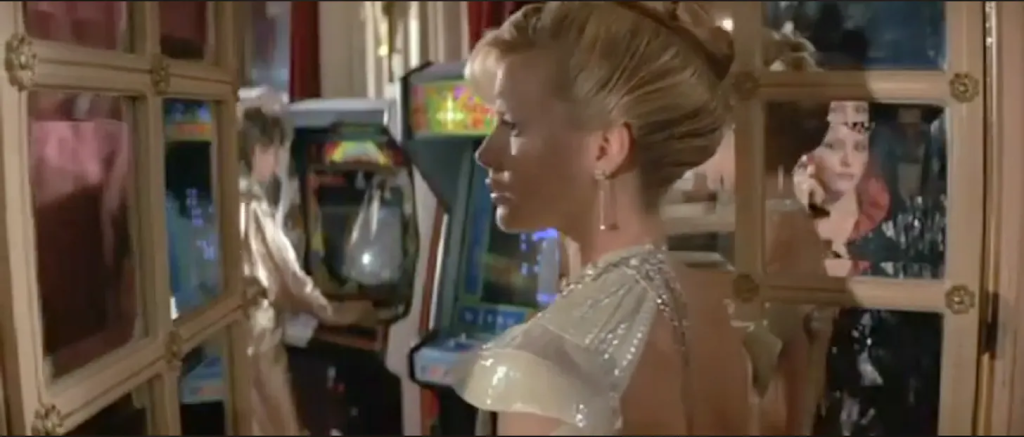
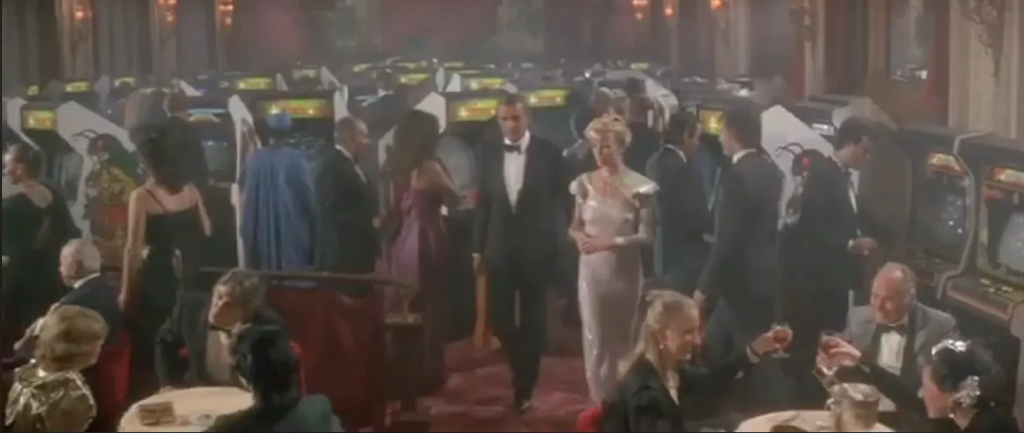
Domino Petachi (Kim Basinger) opens two double glass doors, revealing a host of arcade games on the other side. Many guests dressed in dinner jackets and the like are playing the games. A bit of a juxtaposition from the usual Bond casino scenes.
Bond gives his infamous introduction, “Bond, James Bond”, while standing between Gravitar and Dig Dug, perhaps the first and last time Bond will ever be in such a position.
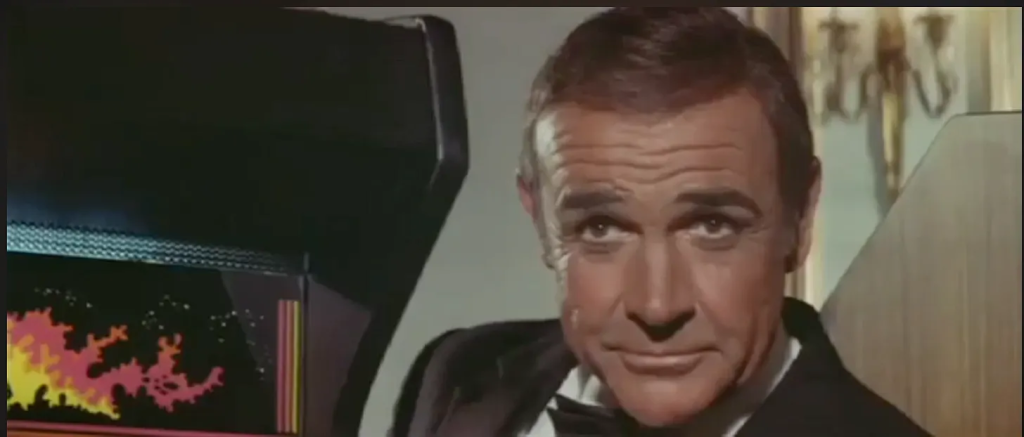
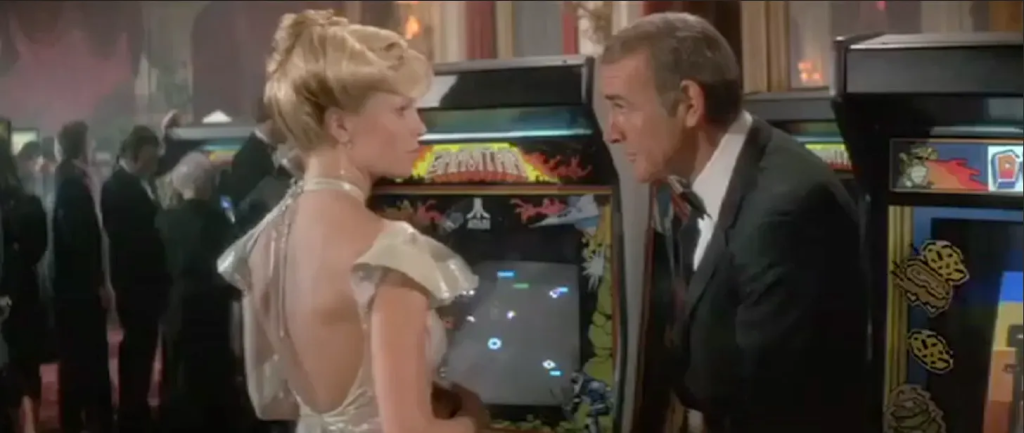
Throughout the scene, there is a noticeable abundance of centipede machines for some reason; if the objective of this promotion was to show Atari’s variety, then they kind of failed on that front.
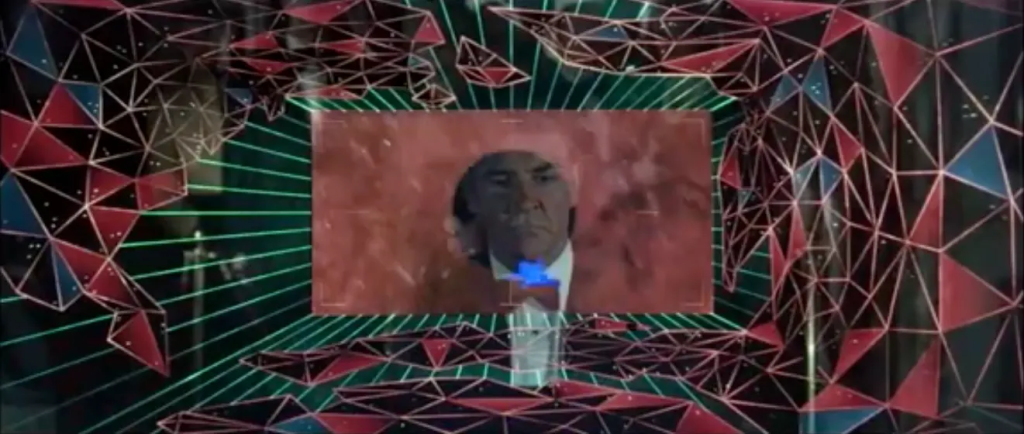
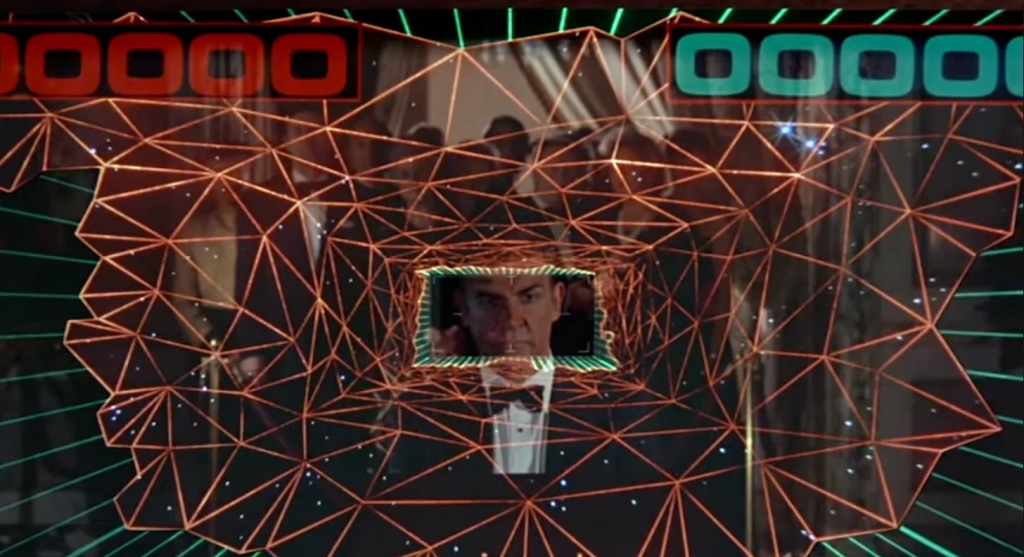
A little later, Maxamillian Largo (Klaus Maria Brandauer) challenges Bond to a game of Domination.A game Largo claims to have invented himself. Appearance-wise, it looks like a long, wooden antique table that has arcade joysticks and buttons on either side with retractable screens for each player. The middle of the table has a see-through “window”, a projector-like screen.
The Domination game also speaks with some sort of computer-synthesised robot voice, not too dissimilar to those found in Berserk (80) , The Matel Intellivoice series of games, or the Cylons from Battle Stargalattica (78), a later example, Zero Wing (89)
The “gameplay” is basically some sort of capture-the-territory game. Random countries “targets” are selected, then players gain territory by launching missiles at each other or something; honestly, even though it’s explained, it’s not 100% clear how the game actually works, and given the complexity of games back then, it’s entirely over-engineered.

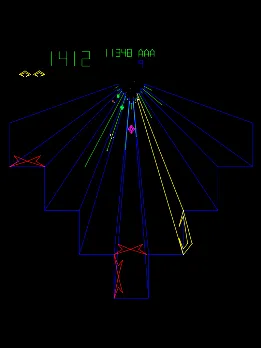
To me at least, it bears a passing visual comparison to the likes of Tempest (81, Atari), and the objective of capturing territories reminded me a bit of Qix (81, Taito ). The prospect of video games and what they could actually do might still have been a bit of a mysterious concept for mainstream audiences, who may only have had a basic knowledge of video games. (In a similar way that hacking and the internet were fairly unrealistically portrayed in the late 90s and earily 200s.)


In the original novel and film, Thunderball, Bond plays baccarat. Never say never again, drastically re-imagine this scene, modernising it for the then current 80s. Visually, it stands out quite a bit and adds some action to what could otherwise have been just another Bond Casino scene.

Arcades in order of appearance.
Centipede (European version) (1981) Atari
Gravitar (European version) (1982) Atari
Dig Dug (European version) (1982) Namco
The machines used in the scene are the European version of the games and likely originate from Atari’s EU manufacturing base in Ireland. The scenes were shot at Waddesdon Manor, Aylesbury, Buckinghamshire, England. (Ah! The magic of filmmaking.)
I suppose the logic of reimagining the Baccarat scene was that “Card games are old-fashioned and boring; video games are the new thing.” I think the fact that they tried to reimagine a classic Bond staple was a good idea instead of rehashing the same drawn-out card games we’ve seen before.
However, while it may have come across as innovative in the early 80s, retrospectively it hasn’t aged that well and comes off as a fairly random snapshot of the early 80s video game craze. The card games arguably have a timeless appeal, unaffected by changes in technology.
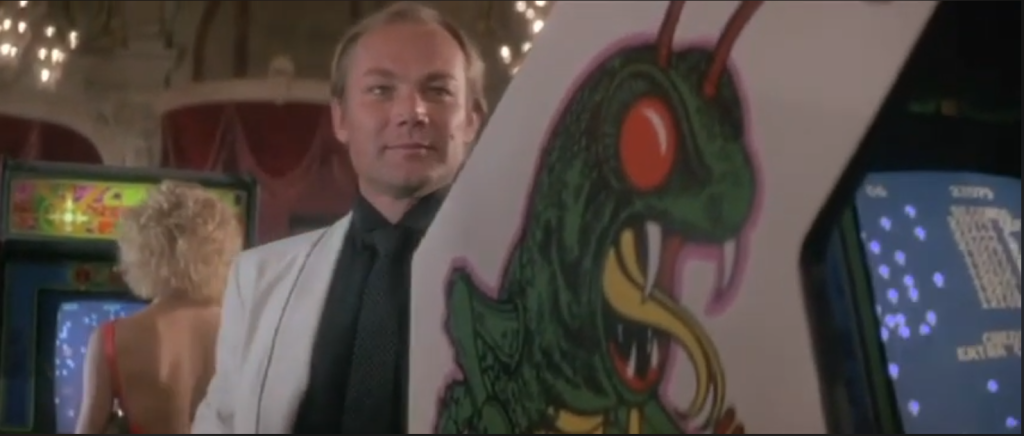
While there isn’t anything outright strange about the arcades’ appearance for me, there is at least some sort of disconnect. I think it’s because the Bond films exist in their own fantastic world of unreality; it’s strange to see something commercial and everyday like a video game in the world of 007. I think there’s also something to Bond, and by extension Connery, being associated with video games, something I can’t imagine either taking the time to play.
The “Game” and its effects were designed by David Dryer and his team. The game is entirely fictional; it doesn’t actually exist, so no one is really playing.
Not strictly an arcade, so there aren’t really any direct comparisons, as always with these films. It’s fun to speculate what happens to these machines after filming finishes. Most likely, they went back to the Atari distributor and were then sent out to arcades across the UK and Ireland, and maybe the EU; who now owns the Dig Dug Sean Connery stood next to, the world will (almost definitely) never know.
Games not on film
The whole thing was a rather blatant and somewhat forced product placement for Atari. Interestingly, though, there appear to be only 3 machines with a large number of centipedes, so it would seem counterintuitive not to showcase a wider variety of Atari games.
It’s not so uncommon for film and TV to invent their own fake video game and console names. This is done mainly for practical reasons, to reduce production costs by not featuring, showing or mentioning branded content. Previous Games on Film like Full House (GOF #14) created the fake name Montezano’s Quest. And in Child’s Play 3, the Atari branding on a Lynx is covered up. The machines in this scene are on full display and were clearly part of a larger product placement deal, so what I find interesting is that when it comes to the main set piece, the game Bond and the villain play weren’t Atari-branded.
Then again, I suppose Atari won’t want to be associated with a fictional villain, but it could still have been an Atari machine he modified or something. With all the video games in the film, you’d expect there to have been a tie-in game. However, no such thing exists.
Tie-in video games were still in their infancy at this point,with only a few examples like Raiders of the Lost Ark (82, Atari 2600), E.T. (82, Atari 2600), although it’s fairly easy to imagine an Atari 2600 or arcade version of Domination. Then again, licensing a game, with this particular Bond, along with the legal difficulties from EON Productions and the Fleming Estate, may not have been at all possible. (I don’t know, it’s just speculation.) There were games based on the Bond character around this era, just not one directly based on the Domination game or Never Say Never Again.
The Bond character would, of course, go on to appear in many more iconic video games, notably GoldenEye for the Nintendo 64. Connery also returned to voice the role and lend his likeness in 2005 for a video game adaptation of From Russia with Love.
MINI REVIEW
In the run-up to the film’s release, it was somewhat presented as a return to form for the 007 series, and scheduled to compete with EON Productions newst offical Bond film, Octopussy (83) starring Roger Moore as Bond. The dubbed “Battle of the Bonds” never really happened as the films were released months apart.
The idea of “Bestbond” really comes down to semantics and personal taste. The Moore era, while still delivering the action where it counts, overall took itself a little less seriously and had more comedic elements, while Connery’s Bond still had its fair share of goofier moments; they arguably have a decidedly darker tone. One approach isn’t necessarily better than the other. Personally, I think, like most things, the truth lies somewhere in the middle (a good balance of action, drama,and comedic moments). Bond is at its best when the action is large, bombastic, and the character is mostly serious, with some of that unique British wit and cheek. My personal favourite Bond eras are Dalton and Brosnan.


Despite all the marketing hype of the return of Sean Connery, Never Say Never Again ends up being a fairly run-of-the-mill Bond outing. The action is good, and Connery is (mostly) in fine form. The film touches all the expected Bond things, but everything is altogether a little too charming and winking to the audience. Bond is a series that made pushing the envelope a full-time career, so ludicrous plots and characters are nothing new. For me, this is the most apparent, with the film’s ending that incorporates a lot of the spy movie clichés that almost verge on an Austin Powers level.
The film is a little hampered by the legal stuff; it couldn’t venture too far outside the confines of the Thunderball source material, though it does invent some of its own ideas. (such as the Domination arcade game.)
The story of this film’s creation is perhaps more interesting than the film itself. The media landscape is a lot different now, with big studios and company mergers and the like, and that seems to happen rather frequently (Wasn’t there supposed to be laws against monopolies or something, or did we just move past that?)
For instance, SONY currently owns the Film and TV rights to Spider-Man, so it has to be loaned out to Disney (which owns Marvel, who own the comic book rights) to appear in Marvel movies (what the duck?)
Never Say Never Again’s unofficial status gives it a slightly rebellious sort of meta appeal. It can be almost like discovering something secret and hidden, as it’s not often (if ever?) included in 007 DVD boxsets, so its apparent lack of availability also makes it sort-after.

Conclusion
In some ways, this is an ideal “Game on Film”; it’s an unanticipated video game showing up in the last place you’d expect to see it. For instance, finding a pinball or arcade machine that takes place in a bar or truck stop isn’t out of the ordinary and is something you could likely experience yourself. While the chances of finding video games at some stately mansion are a lot less likely. A downside is that Bond doesn’t actually play any of the arcade games.
It was, of course, cool as ever, to see some early arcade classics, and it was twice as nice to see some EU representation; it sort of breaks the norm to see something outside of the standard or North American machines all the time.
The film is your standard Bond outing, perhaps a little underwhelming when compared to Connery in his prime. The story behind its production, for some, might help add to the film’s allure. It can’t be denied, however, that Never Say Never Again isn’t at least an interesting stop on the Bond film timeline.