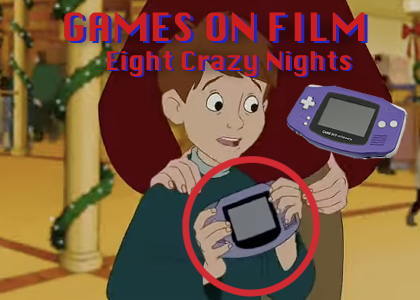
Today’s game on film is…
Game Boy Advance (2001)
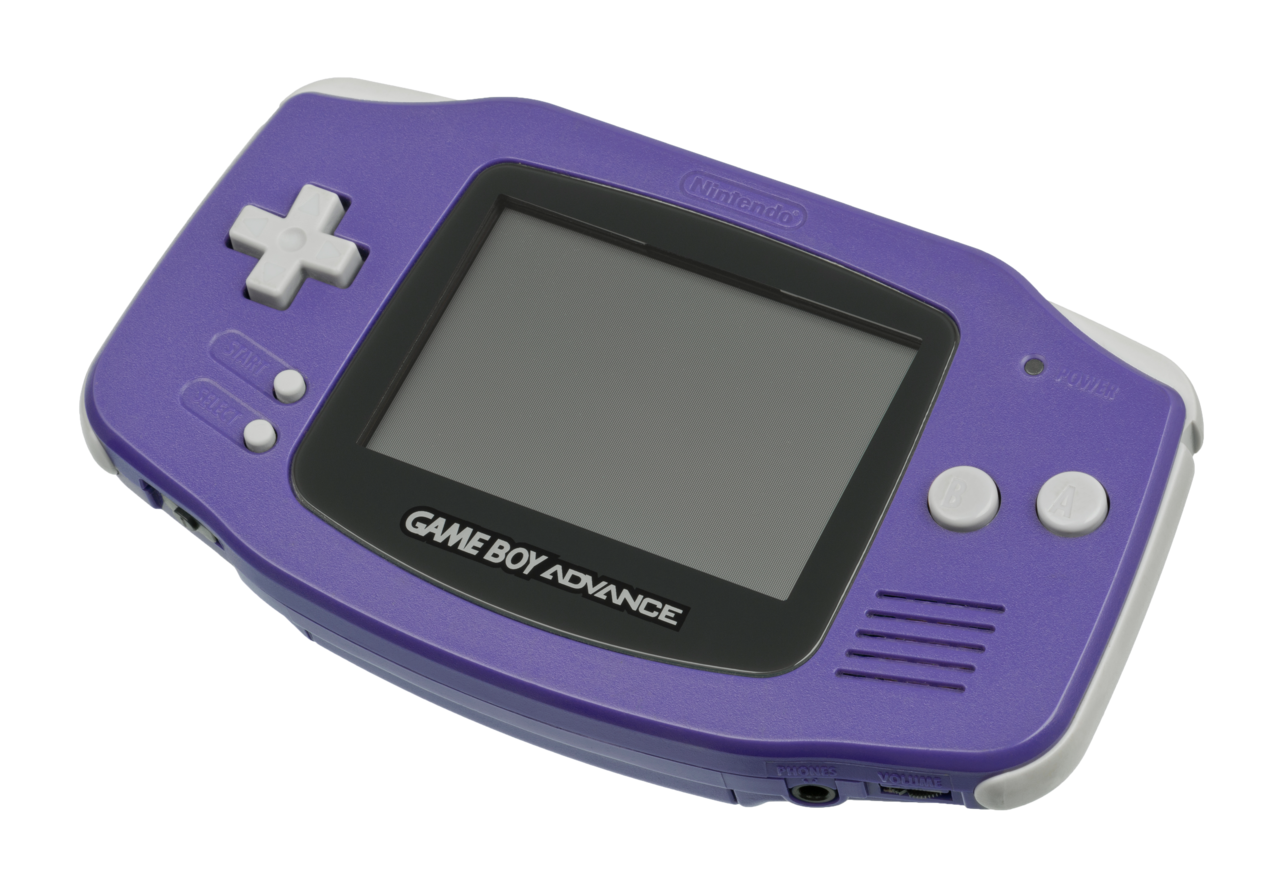
Game Boy Advance (2001)
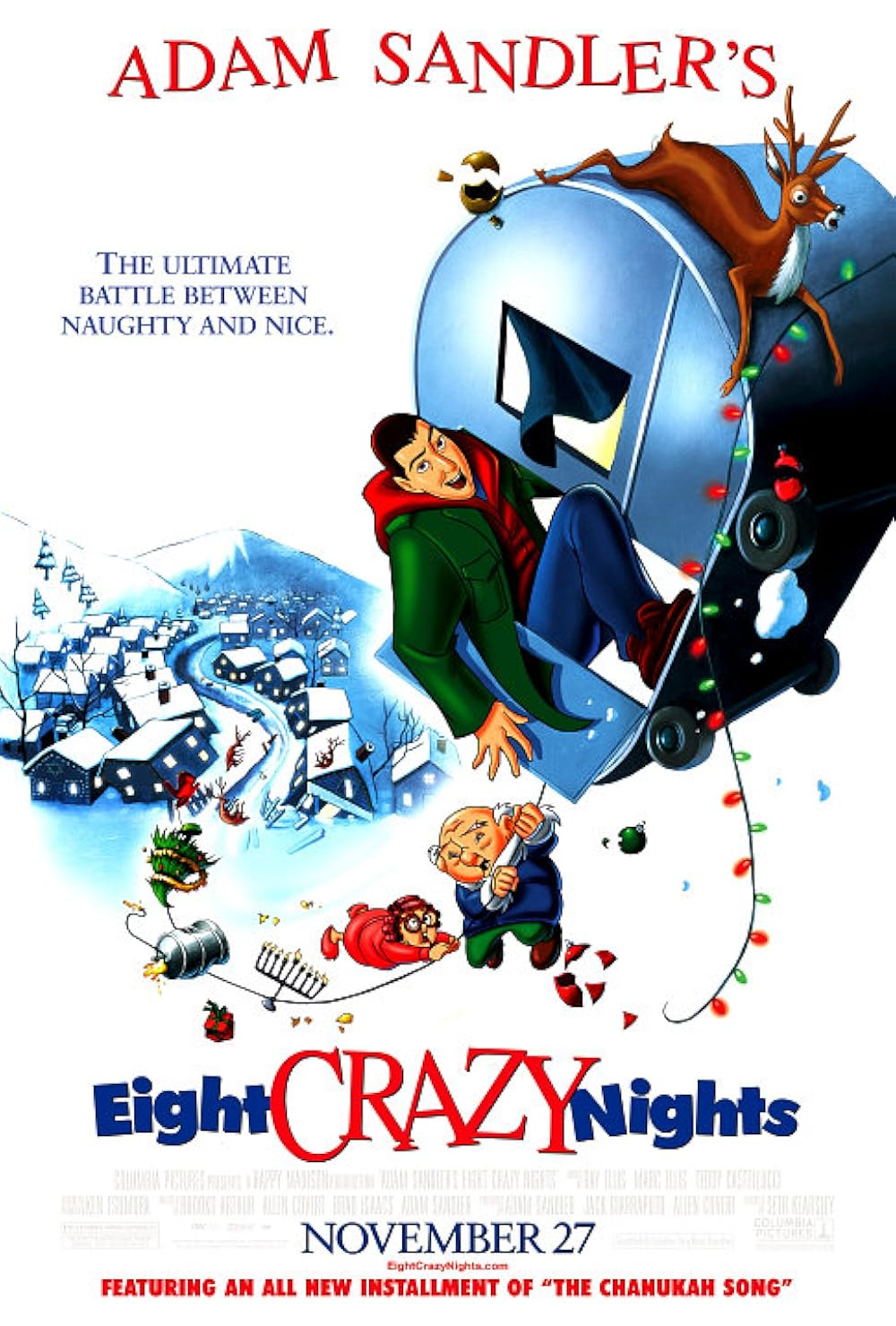
Eight Crazy Nights (2002) is an animated musical comedy directed by Seth Kearsley and written by Adam Sandler, Allen Covert, Brooks Arthur, and Brad Isaacs. *
In a cinematic world dominated by copy-and-paste, Hallmark Holiday Movies, mainstream Hanukkah-themed feature films can be somewhat hard to find.
Animation has developed a stigma that it’s only intended for kids, while this has never really been the case. Finding good Animated films that feature more complex “adult” themes can be fairly rare, so they stand out when they come along. Films like Heavy Metal (1981) and many of Ralph Bakshi’s films, such as Wizards and Fritz the Cat, feature high concepts, interesting characters, philosophical, and culturally challenging ideas presented through stunning artwork and animation.
Eight Crazy Nights was released during an era when 3D animation was starting to gain popularity. This leaves the film as a bit of an outlier, being a Hanukkah adult comedy musical film that mainly uses traditional 2D animation. That said, animation certainly makes it stand out, and the film wouldn’t likely have stuck in the cultural zeitgeist had it been live-action.
Eight Crazy Nights: A synopsis
Davey Stone, a down-on-his-luck delinquent, hates the holidays, himself, and everyone else. He faces jail time after drunkenly destroying the town’s Christmas and Hanukkah ice sculpture display. Fortunately, Whitey Duvall, a short, eccentric old man, takes on Davey to serve his community service, refereeing the kids’ basketball team. Despite Whitey’s help, Davey continues his bad ways.
Later, Davey is reintroduced to Jennifer Friedman, a recent widower and old high school friend, who now has a son, Benjamin (also on the basketball team). Jennifer is disappointed to see that Davey is a shadow of his younger self.
Whitey, despite his unselfish acts, remains underappreciated and unrespected by the town. He dreams of winning the Dukesberry All-Star Patch (that happens to be the 35th anniversary of the event), which he has missed out on every year.
Later, it’s revealed that Davey’s parents died during the holidays when he was twelve, which is why he harbours resentment for the season and life in general. Spending time with Whitey and learning about his charitable acts, Davey turns a new leaf.
Davey is heartbroken to see Whitey’s unjust loss of the 35th star patch. He rallies the town to support Whitey. Whitey gets his reward, along with the whole town, symbolically giving them their patches from previous years.
Davey is reformed, hinting at a brighter future and a possible relationship with Jennifer and her son.
The scene
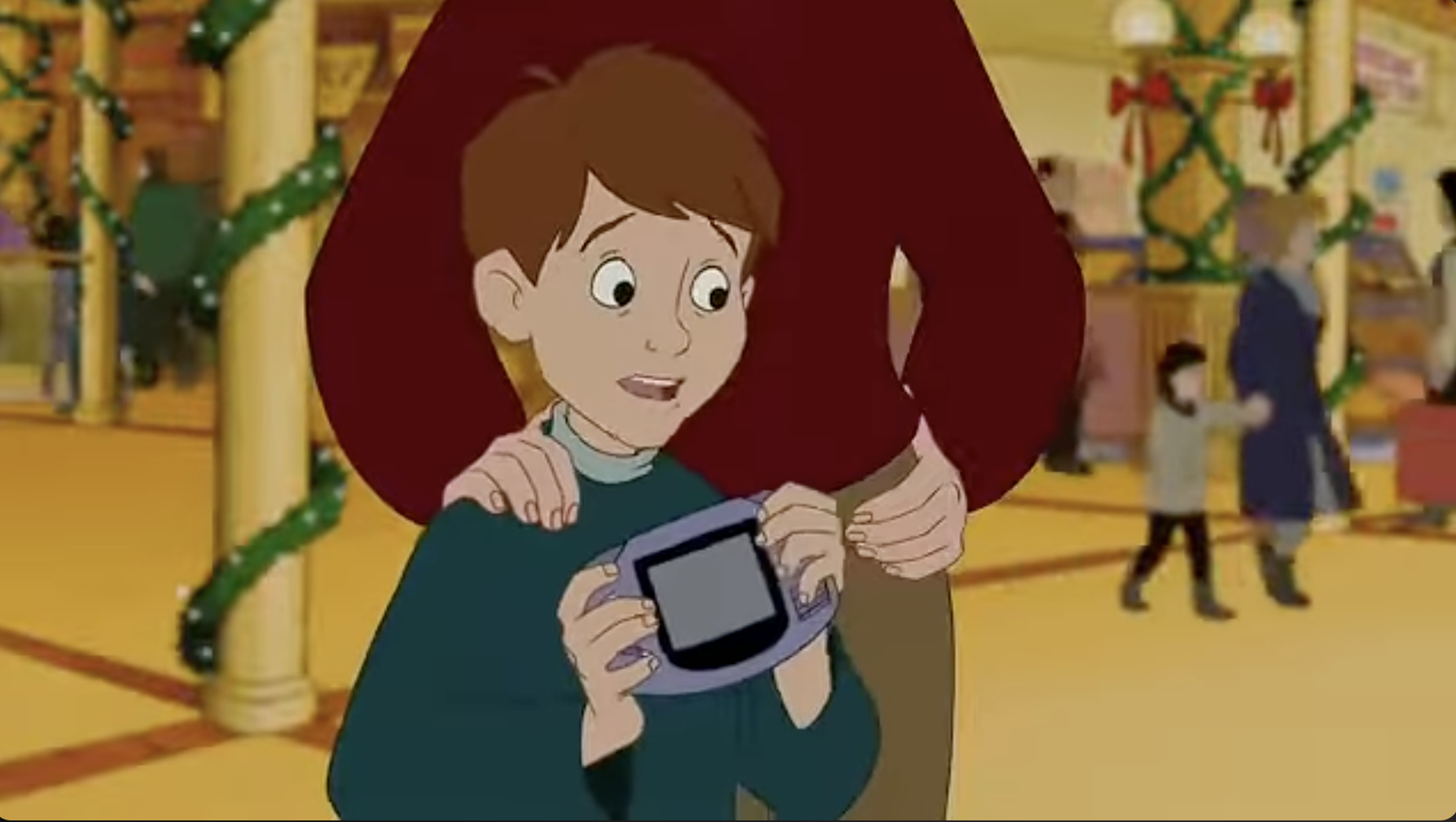
Soon after taking on Davey, Whitey takes him to the mall, after Whitey talks about how much he enjoys the mall and all its stores, making sure to include as many brand names as possible. They go to the mall’s food court, where Davey is reintroduced to his estranged friend from high school, Jennifer Friedman (Jackie Titone) and her son Benjamin (Austin Stout), who has received a Game Boy Advance as one of his Hanukkah gifts. Although in the scene, it is only ever referred to as a “Gameboy” after Whitey mistakenly thinks it’s an Etch-a-Sketch.
The GBA is fairly detailed, as one might expect, given the quality of the animation. It is, however, missing the Nintendo and the Game Boy Advance logo. This may have been some sort of licensing issue, although given all the other licensed names, mascots and logos that appear later in the film. makes this example stand out a little more.

It’s Advancing on Ya
The Game Boy Advance launched on March 21, 2001, in Japan, June 11, 2001, in North America and June 22, 2001, in Europe. It was the 32-bit follow-up to the Game Boy Color (1998). As the name boldly claims, it was Nintendo’s most advanced handheld yet. capable of replicating graphics and gameplay that were on par with the SNES. The GBA in the right hands could even pull off some impressive 3D visuals.
The GBA was quite innovative for its time, with its connectivity to the Gamecube, with games like Zelda: Wind Waker, and PAC-MAN VS., to name just two. The GBA also had interesting add-ons, such as the “e-reader” that allowed players to swipe cards to unlock features certain GBA games like Mario Advance 4: Super Mario 3 or play a select number of NES games.
The GBA was a hugely popular handheld, selling 81.51 million units in its lifetime. Despite the improved graphics and sound, the system still lacked a native front or backlight, making playing in poorly lit areas almost impossible. This was rectified with the Improved Game Boy Advance SP (2003) that had a new clamshell design and a front-lit screen. (Finally, you could play in the dark without using one of those worm light thingies.) The original Nintendo DS (2004) and Nintendo DS Lite (2006) were backwards compatible with the GBA. In 2023, GBA titles were added to Nintendo Switch Online.
Eight Crazy Nights in Review
Coming at it as someone who isn’t overly familiar with Adam Sandler’s filmography, and not really being a fan, I’m not the film’s prime demographic, then again, I like animation, I like comedy and musicals, what could go wrong?
The film was animated by the collaborative efforts of several different animation studios, including teams that worked on the classic The Iron Giant (1999). This is one point everyone seems to agree on. The film is beautifully animated, a mix of hand-drawn 2D traditional animation and 3D animation elements, the two are effectively blended together and is a style of 2D/3D I wish had continued.
Narratively, the film takes the tried and tested “A Christmas Carol” formula of redemption, so in some respects, the overall narrative isn’t that inherently original. This leaves the characters themselves and the jokes to carry the film; the effect of this will vary greatly on your sense of humour.
Generally, the humour is quite crude, often falling back on toilet humour, and that one infamous scene with the deers (if you know, you know) and has some stereotypical type and racial jokes that wouldn’t fly today. The film’s style of humour was a sticking point with a lot of critics when the film first came out, and is something that often overshadows what the film gets right, like the animation and music.
While humour is subjective, the cruder jokes and jokes that haven’t aged well, unfortunately, bring down the emotional and character-based parts of the film that do work.
Sandler provides several voices for the film, including two of the main characters. Davey is fine because it’s basically just his regular speaking voice; However, Whitey Duvall has a squeaky, highly-pitched voice that can become annoying. He also voices Whitey’s sister Eleanor, whose voice is far less grating. Sandler himself has a good singing voice, and credit has to be given to him for being able to sing while maintaining his character as Whitey and Eleanor.
The film is aimed at Sandler’s usual audience, but it does at times come across as if Adam Sandler couldn’t decide if he wanted to make a nice family holiday film or a crude adult comedy for teenage boys. This inconsistency leaves the film in a strange limbo where it doesn’t really satisfy any one audience.
Despite some nice set pieces and musical numbers, it wastes time on reiterating the same plot points. For instance, when you think Davey has changed his ways, he immediately reverts to his old ways.
Character arcs feel rushed, a romantic subplot that is introduced and resolved so quickly it’s in danger of giving you whiplash, not to mention feeling entirely unearned.
This, unfortunately, also brings down the musical numbers that are well written and performed. While I think adult humour and jokes can work as lyrics, in Eight Crazy Nights’ case, it doesn’t always work out. It would be like if Kermit in a muppets Christmas Carol, after finishing “One More Sleep ‘Til Christmas”, slips on some dog shit and falls over.
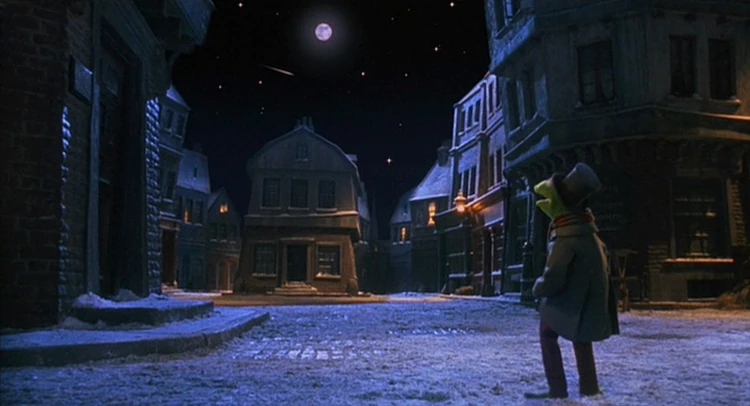
Bum biddy, biddy, biddy, bum bum
Where would a musical be without its songs? Thankfully, the music and songwriting are quite good across the board. However, at times, some of the “joke lyrics” feel a little forced and don’t always land or fit. Sandler’s singing voice is actually good as Davey; the same can’t be said for Whitey, so if you were annoyed by his speaking voice, his musical number might be a bridge too far.
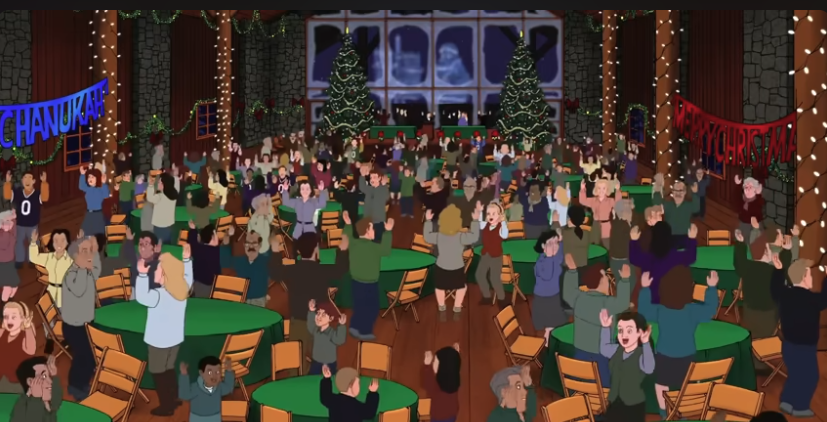
The songs were written by Sandler, Brooks Arthur, Brad Isaacs, Robert Smigel, Allen Covert and Steven Brill, with music composed by Teddy Castellucci, along with Marc Ellis and Ray Ellis.
For me, some highlights include the opening song “Davey’s Song, which makes for a good character introduction and sets the tone for the whole movie.
“Technical Foul” is perhaps the best example of a song that narratively and characteristically works, and to me feels the most like the kind of thing you might find in a satirical Broadway musical.
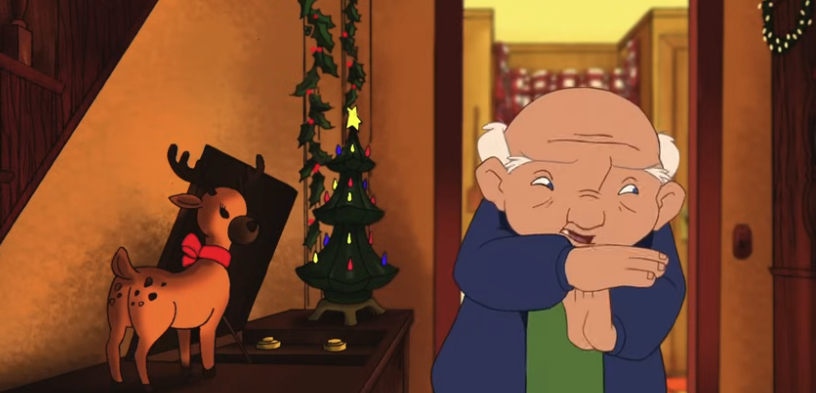
Even those who haven’t seen the film are familiar with “Bum Biddy” It’s strangely catchy and, of course, draws from much better source material, Fiddler on the Roof (1971). Again, this is a great showcase for the scale and talent of the animation.
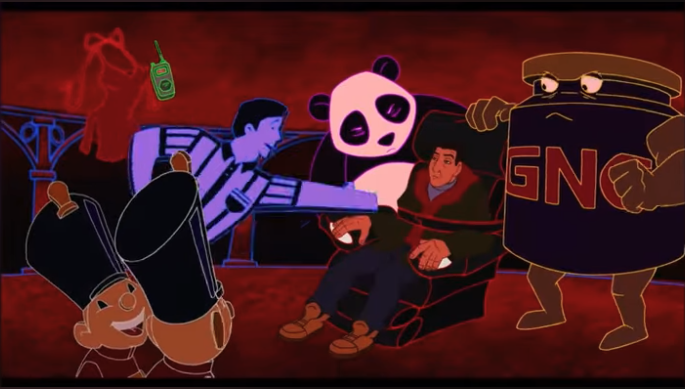
The “Intervention Song,” which is supposed to be the emotional climax of the film, is when Davey is at his lowest point. Again, the narrative animation and music really come together; however, even this segment is undercut slightly by the emotional climax of the film being delivered by corporate mascots. speaking of which…
Product Placement Problem
Sandler movies have gained a reputation for there in your face product placement, and while this film is no exception, it at least uses it in a somewhat interesting way that only animation could achieve. Parts of the film take place in a mall, so it’s only natural that there would be stores. when the logos/mascots come alive for what it’s worth, they animate quite nicely, such as the Panda Express logo.
Still, what is supposed to be an emotional high point of the film, is undercut by it being sung by corporate logos.
Product placement doesn’t have to be bad; it’s a part of modern mainstream filmmaking, and when done right, as it should be, it can feel natural in the background. If it can be incorporated in a way that doesn’t feel forced, then that’s a bonus. Such as in Wayne’s World (1992) when the product placement is used as a bit.
More cynical critics might say seeing video games in films counts as some sort of product placement, and while this may be true in some cases, most of the examples I have looked at have all had some connection to the larger narrative, in turn justifying their inclusion, working with the story and not being included just to cash a cheque. (A “cheque” is something people used to use approximately 1 million years ago as a form of payment for goods and services.)
To conclude
The film has many peaks and valleys, where its best moments are undone by crude toilet humour and hit-and-miss jokes. Eight Crazy Nights is disappointing because it could have been so much more; and it is one instance where a remake or sequel, if done with the same animation style and if the story and characters were reworked and fixed up, this film could be a certified classic.
(Sigh, somewhere in an alternative universe, there is a version of Eight Crazy Nights that doesn’t entirely suck.)
* Main Cast
Adam Sandler: Davey Stone, Whitey Duvall, Eleanore Duvall/Josh Uhler (Young Davey)
Jackie Titone: Jennifer Friedman/Alison Krauss (Singing voice), singing voice/Ali Hoffman (younger Jennifer)
Austin Stout: Benjamin Friedman/Jason Houseman (singing voice)
Rob Schneider: The narrator, Mr. Chang
Kevin Nealon as Mayor Dewey James Barbour (singing voice)
Carmen Filpi: Homeless man
Norm Crosby: Judge
Jon Lovitz: Tom Baltezor
With many other cameo/guest voices, such as Carl Weathers as the GNC bottle and Tom Kenny as the Sharper Image chair.
EIGHT CRAZY NIGHTS
Columbia Pictures, Happy Madison Productions, Meatball Animation Studio
Muppets still
Walt Disney Pictures
Jim Henson Productions
Buena Vista Pictures Distribution