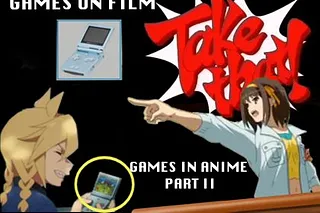
Today’s games on film is …
Game Boy Advanced SP (2003)

UmaMusume: Cinderella Grey
Season 1 Episode 4
The Junior Crown/(ジュニアクラウン, junia kuraun
(original arid April 27, 2025)
Uma Musume: Cinderella Grey is a spin-off of the main series Uma Musume: Pretty Derby, based on the highly popular mobile game of the same name from Cygames. At the time of writing (Dec 2025), the game was voted “Mobile game of the year 2025” by the Game Awards.
Gameplay is a mix of visual novel and management strategy. Incorporating real-world horse racing history and stats, with J-pop Idol culture. Players (Trainers) choosing an Uma to train to compete in races. The players’ choices in training have a direct effect on the outcome of the races.
Like most mobile games, there is an element of random gotcha mechanics where a new character can be “unlocked”. All in all, it has quite a unique concept and a charming and diverse cast of characters. Players’ mileage may vary depending on how much they like management sims and visual novel-style storytelling. Who knows if the series’s popularity continues to grow, there could be more games outside of the mobile games realm on their way.

The Anime
The series follows the racing career of Oguri Cap, like all the great sports legends, it’s an underdog (underhorse) story of triumphing under adversity and beating the odds. In this episode, Oguri Cap races against her strongest rival up to this point, Fujimasa March, in the Junior Crown.
The scene
Although it’s difficult to see, they are playing what seems to be some kind of horse racing-themed game, with a “behind-the-driver-view” similar to Mario Kart. Mario Kart Super Circuit (2001) was one of the system’s games that used the link cable for multiplayer. In the context of the scene, it looks like they are supposed to be playing a multiplayer game; the only problem is that there is no link cable.
The Game Boy Advance SP (2003) was a clamshell redesign follow-up to the Game Boy Advance (2001). Its biggest innovations were a front-lit screen and a rechargeable battery. Later, it was improved on even more, with the Game Boy Advance SP (AGS-101) that added an improved back-lit screen.
(Flashback) Rudy Lemono, Mini the Lady and Norn Ace “horsing around” playing Game Boy.

1.21 Gigawatts (Overthinking about horses and timelines)
Some fans have noticed that the English subtitles for one of the episodes include the date 1987. This has sparked debate as to just what time and universe the series takes place in.
The real-life horse Oguri Cap that the anime and Manga are (loosely?) based on made its debut in 1987. Nothing in the series would suggest it takes place in the late 80s. It’s mostly shown as a contemporary 21st-century setting with modern technology such as smartphones. Another way of looking at it, if it had been set in the 80s, the original Game Boy wouldn’t have even been out at this point, let alone the SP.
The Uma Musume series already takes many liberties with its source material, such as horses that have long since passed still having their uma counterparts being alive. I think this can be put down to an overzealous subtitler, trying to connect the two lore.
The Melancholy of Haruhi Suzumiya
Season 1 episode 8 (Chronologically S2 EP11)
Remote Island Syndrome Part 2/ Kotō Shōkōgun (Kōhen)
(孤島症候群(後編)) (original aired May 21, 2006)
The Melancholy of Haruhi Suzumiya, created and written by Nagaru Tanigawa, first as a series of light novels, with illustrations by Noizi Ito. Followed by a Manga adaptation by Makoto Mizuno. Two seasons of an anime, two movies, and several video game adaptations, and other merchandise, and collectables.
The series follows Haruhi Suzumiya, a highly spirited and bold high school girl who consistently seeks adventure. She befriends Kyo, one of her classmates and just a regular guy. Later, they are joined by Mikuru Asahina, who is really a time traveller, Yuki Nagato, who is actually an alien, and Itsuki Koizumi, who is in reality an esper. These three have been collectively sent to keep track of Haruhi, who is blissfully unaware that she has the ability to destroy the entire universe if she ever gets too bored. They create a school club called the SOS Brigade along with Haruhi and Kyo to ensure she never gets bored. All the while, Haruhi remains unaware of her friends’ true identities. Something else of note: The anime series was originally broadcast in a non-linear order, meaning you’d have to watch them out of broadcast sequence to get the full story.
Haruhi Suzumiya light novel volume 1 cover. Published: Kadokawa Shoten Written: Nagaru Tanigawa Art: Noizi Ito


A quick synopsis
In part 1, the SOS brigade travels to a remote island to visit Keiichi Tamaru,a supposed distant relative of Koizumi. While on the island, Tamaru is seemingly murdered by an unknown assailant. Haruhi, who had been looking for a mystery to get suck into, turns detective and starts an investigation
In part 2, Haruhi continues her investigation, eventually coming to the now obvious conclusion that the whole thing had been staged and that “There was never a murder to begin with, Mr Keiichi, was is and has always been alive!”
The scene
So, not so much an actual game as a full-on parody of one. This episode features several references to the Ace Attorney video game series from Capcom. During Haruhi’s deduction, she mimics poses very similar to Phoenix Wright, the main player character from Capcom’s Ace Attorney series. Itsuki Koizumi also does Miles Edworth Bow and a smug head shake.
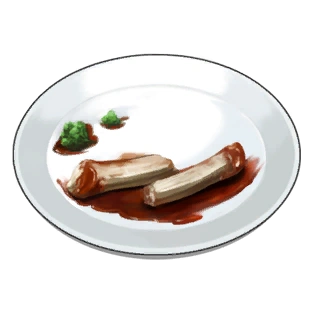
While not a out outright reference, one of the “clues” in the episode is that the “victim” is the only one on the island who eats with a knife and fork. To me, the plate could be a possible reference to a clue from the Turnabout Samurai case from the first game (Phoenix Wright Ace Attorney, 2005), where a plate with a steak bone is used as evidence. Or, it’s just a plate.

As parodies go, this is a really good one. It pays a lot of attention to detail in the character posing and animation to replicate the source material. It also ties in to the episode narrative quite nicely without feeling forced and is subtle enough that those unfamiliar with Phoenix Wright that the scene still work on face value.


This brief moment in the episode resonated with fans so much to the point it inspired a fan game, The Turnabout of Haruhi Suzumiya (Suzumiya Haruhi no Gyakuten), created by CUBETYPE.
The game shares the same style and gameplay as the Ace Attorney series, but with The Melancholy of Haruhi Suzumiya characters and an original narrative.


Phoenix Wright may at first seem like a bit of an oddball concept for a game. A game where you play as a lawyer, gathering clues, questioning witnesses, and cross-examining evidence. Each case ends with a fast-paced duel of wits in court. Capcom pulls it off with interesting and well-written characters and cases, which at times can be brilliantly hilarious to deeply moving.
While the series gained global popularity on the Nintendo DS, the series actually originated on the Game Boy Advance (only in Japan, of course). The DS versions were the first in a long series of ports. Including remastered in HD for the Nintendo Switch, and even received an iOS version. The original trilogy was also ported to the Nintendo Wii, which incorporated motion control as part of the WiiWare brand.


The finish line (to conclude)
Seeing video games in Anime always hits a little different. Maybe it’s because they had to take the time to actually draw and animate these details. The attention to detail is appreciated not just in these references, but anytime animators decide to do something a little extra and include something that is a clear (but legally distinct) depiction of some of our favourite systems instead of choosing to do something generic or not do anything at all.
Visual representation of games and consoles is one thing, but when the show’s creative team include actual parodies of material, I feel that it goes the extra mile. While there are a few examples of this in live action film and TV, I think animation is uniquely suited to these kinds of parodies, not just as it pertains to anime, but western cartoons as well (More on that later).
Some previous examples I’ve covered include My Deer friend Nokotan (see GOF#10), which made a number of direct parodies and references, including Pokémon, specifically when Nokotan “evolves” from a deer to a moose. And a parody of the Dark Souls “You died” game-over screen in the anime’s opening credits. There are many more examples left to cover, so stay tuned for more video game references in anime.
Thanks to the following resources that helped when researching for this GOF.
CygamesPictures
umamusu.wiki
haruhi.fandom.com
aceattorney.fandom
Credits: Strabo412 / Sligneris (Desk Slam) Via: aceattorney.fandom