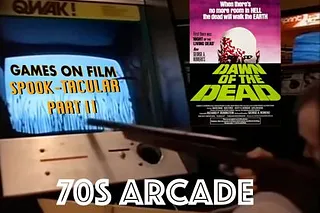
Todays games on film are..
Qwak!: Developed: Cyan Engineering Release: Nov 1974 (NA), July 1975 (JPN)
-
Gangbusters: Developer: Midway Manufacturing Co.Release: 1974
-
Steeplechase: Developer Kee Games (Atari)Release: NA: October 1975 (NA) 1975 (EU) January 1976 (JPN)
-
Sprite 2: Developer: Kee Games (Atari) Release: 1976, 1977 (JPN)
-
F-1:Developer: Namco Oct 1976 (JPN) NOV 1976 (NA)
-
Gun Fight: Developer: Tatio Released: 1975
-
Night Driver: Developer: Atari Inc. Released: 1976
-
Starship 1: Developer: Atari Inc. Released: 1977

Dawn of the Dead (1978) Written and directed by George A. Romero.
Starrting
Gaylen Ross…Francine “Fran Flygirl” Parker
David Emge…Stephen “Flyboy” Andrews
Ken Foree…Peter Washington
Scott Reiniger…Roger “Trooper” DeMarco
With special make up effects by Tom Savini.
The film is a follow-up to Night of the Living Dead (1968); Dawn of the Dead is less of a direct sequel than a film that offers an alternative perspective on the same idea of a world under a zombie apocalypse. It’s never directly said, nor would it make sense time-wise, going from the late 60s to the late 70s, but I’ve always felt like both this and the original take place at the same time.
A brief synopsis (spoilers)
Dawn of the Dead follows four survivors trying to escape the zombie apocalypse. They take refuge in an abandoned Mall. They soon adapt and start to live a more comfortable life. Zombies aren’t the only danger; later, they must fend off a gang of bikers that tries to take control of the Mall for themselves. They beat the bikers, but still have the zombies to deal with, a situation they can no longer handle. Only two of the survivors are able to get out alive. The film ends on a slightly more optimistic note than the first film, but still with an underlying forebodingness.
The film is a masterful blend of action, horror, and gore, with a good amount of social satire. The most obvious of which is the not-so-subtle comment on consumerism, comparing Mall shoppers to zombies, a sentiment that still rings true today, although the setting is now shopping online. Similar to the original, the film also touches on philosophical and moral ideas. It silently offers the audience the question, “What would you do in this situation?”
Dawn of the Dead has three distinct cuts of the film: The US theatrical, the Director’s Cut (Cannes cut), and the Argento Cut.
Each cut has its good points and bad points. I’d say they’re all worth watching; each one is different enough from the other to make it worthwhile. Though your mileage may vary. The Argento cut, intended for the European market, removes most of the humour and ups the gore and goes for a more serious tone. The director’s cut Cannes cut) has some more character development. The theatrical cut sets a good balance between the three and is the one most audiences have probably seen. Each cut has its value and all three are worth watching, so you can’t miss.
The Scene
In a brief moment of respite, the characters indulge in the luxury of having the mall to themselves. One of the things they do is play games at the mall’s arcade.
(Close to) Order of appearance.
Qwak!
Developed: Cyan Engineering
Designer: Ron Milner
Publisher: Atari (NA) Namco (JPN)
Release: Nov 1974 (NA), July 1975 (JPN)
The game is a fairly basic light gun game; the objective is to shoot the ducks that fly on screen. Potentially served as inspiration for Duck Hunt (1984,Nintendo).


Gangbusters
Developer: Midway Manufacturing Co.
Release: 1974
An electro-mechanical shooting gallery-style game, with a gangster theme.

Steeplechase (NOT PLAYED)
Developer Kee Games (Atari)
Publisher: Atari, Inc. (Na/EU) Nakamura Seisakusho (Namco) (JPN)
Release: NA: October 1975 (NA) 1975 (EU) January 1976 (JPN)
A video arcade horse racing game allows up to 6 players.
Sprite 2
Developer: Kee Games (Atari)
Published: Kee Games (NA/EU) Namco (JPN)
Release: 1976, 1977 (JPN)
A video arcade rally racing game. Features steering wheels on the machine.
F-1
Developer: Namco
Release: Oct 1976 (JPN) NOV 1976 (NA)
Electromechanical arcade F-1 racing game. Seated cockpit design with a steering wheel.


Gun Fight
Publisher: (JPN/EU) Taito Midway Manufacturing (NA)
Release: 1975
Video arcade wild west theme, quite similar to Outlaw on Atari

Night Driver
Developer: Atari Inc.
Publisher: Atari Inc. (EU/NA) Namco (JPN)
Release: 1976
Video arcade Driving game, later ported to the Atari 2600 in 1980.

Starship 1
Developer: Atari Inc.
Publisher: Atari Inc. (NA/EU) Namco (JPN)
Release: 1977
Video arcade Space Shooter. Also notable for the unauthorised use of ships that look similar to those in Star Trek.

A good mix of early video arcades and electromechanical games, interestingly, no pinball tables are shown. I was unable to identify some of the machines in the back. There is something that could be a pinball machine, but I can’t confirm it. (Stay tuned for updates. If I ever figure out what these machines are, I’ll add them to the list.)


There is a large shape behind Ken Foree that is particularly interesting. It seems too out of place to be another machine. I speculate this might be some kind of black bounce board they used while filming. (Bounce boards used to reflect and soften lights) Furthermore, more to the right of Ken Foree’s shoulder appears to be a C Stand of some sort holding it up.

Mall Madness
The mall was and still is a real place; Monroeville Mall, located in Monroeville, Pennsylvania, of course, it has changed quite a lot in the years after the film’s release. Many vloggers and horror hounds have done location videos on the Mall, and while some key locations can still be spotted, the location of the arcade is unknown. The film leaves it ambiguous, giving no real indication of where it was actually located. (Though common sense might suggest it’s on the same floor as the main department store.) Although in some shots it appears to be part of a larger structure, possibly part of a lobby of a movie theatre.
CAPCOM
Romero’s films have served as inspiration for many other films, comic books, and video games. One of the better and more successful examples is Capcom’s Dead Rising series, which took the zombies-in-a-mall concept and ran with it. Capcom’s other zombie series, Resident Evil (Bio Hazard, in Japan), is now perhaps the most successful horror video game series and helped popularise the term survival horror.
The Japanese commercials for Bio Hazard 2 (Resident Evil 2) enlisted the help of the man himself, George A. Romero, to direct them.
It’s cool to see characters and events from the game being played out in live action, but it does, at times, look like cosplay. (High-end cosplay, mind you) Brad Renfro (1982-2008) played Leon S. Kennedy. He did a good job, but was maybe a little too young looking for the role, and in my opinion, it takes away some of the seriousness and adds to the cosplay factor.

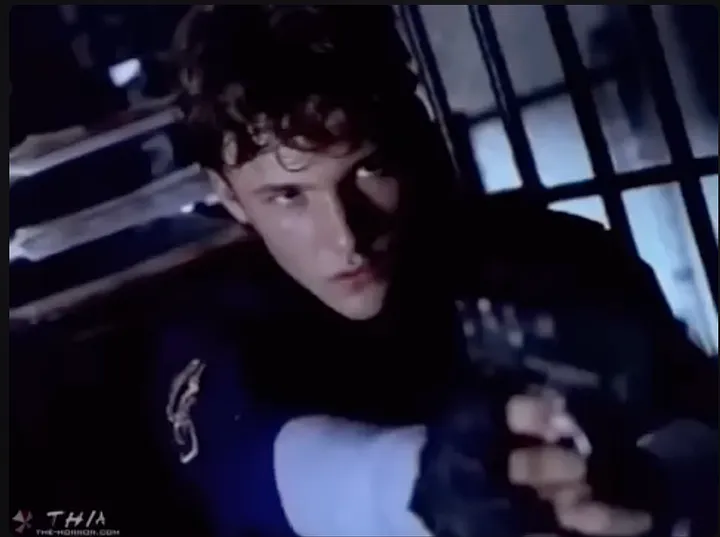
Leon S. Kennedy’s in-game age is supposed to be 21; Renfro would have been around 16-17 at this point. Then again, I suppose they wanted someone in the teen target demographic for the game. Plush Renfro was becoming a more popular and recognisable actor at this time.
Adrienne Frantz played Clare Redfield in the commercial. Claire is supposed to be 19 in the games, and in real life, Frantz was around 20 at the time. So a bit closer to the actual character.


Despite my minor nitpicks, I think this is a really clever and creative video game commercial, something that is few and far between in today’s video game commercial landscape.
It’s clear that a lot of care and attention was taken with this commercial, and it was treated like a real studio shoot. The extra effort shows in the costumes, location, lighting, and zombie makeup. Despite being quite short, it does a really good job at capturing the mood of the game.
Peter Deming was the DOP, and the zombie makeup effects were done by Screaming Mad George (Joji Tani).
In a way, the commercials brought things full circle. Romero’s zombie films inspired the creation of the Resident Evil series, which in turn led to the creation of the commercials directed by Romero. Retrospectively, there is a novelty in seeing these now iconic characters and scenarios played out in live action, but also has a slight bittersweetness to them, giving a what-if look at what a Romero Resident Evil film might have been like, instead of the ones we got.
The Remake?

A brief look at 1978 gaming
The film shows another example of the early days of video games. In a pre-PAC-MAN, pre-Donkey Kong world.
The early 70s brought the first examples of video games with the likes of Computer Space (1971) and PONG (1972), followed by many different PONG clones throughout the 70s. The Magnavox Odyssey was first released in 1972 and is often considered to be the first example of a home console.
By 1978, a number of other early home consoles had been released. While still fairly basic, they were a significant step up from the PONG clones . In 1977, Atari launched the Atari VCS (2600).
The Odyssey 2, September 1978 (NA), December 1978 (EU), was the significantly more advanced follow-up to the Odyssey. Intended as a very user-friendly entry point, although primarily thought of today as a video game, it was also marketed as an educational product.
Bally Astrocade (April 1978) , while not as remembered as the likes of the Atari VCS, for its time, it was a fairly advanced system. It had 4-player capabilities and allowed for basic programming.
APF 1000 1978, a very early 8-bit home console. A fairly forgotten system, with a lacklustre selection of games when compared to the competition.
As shown in the film, Arcades were still primarily a mix of Pinball and electromechanical machines, with a few video Arcades. Things would soon change, however, with Space Invaders (Taito), April 19, 1978 (JPN), November 1978 (NA/EU). While not the first space-themed arcade game, it was one of the first arcade games to become a global success. In many ways, this is where the video arcade era truly began. Not too long after Space Invaders came PAC-MAN (1980), shortly followed by Donkey Kong (1981), and you know the rest…
To Conclude
It’s difficult to recall too many zombie-related films that actually delve much into what entertainment looks like during the zombie apocalypse. There are a few other examples, but Dawn of the Dead is one of the more interesting ones.
It could be because a lot of the games shown are now fairly uncommon and aren’t as easy to find footage of. This brief segment actually offers a somewhat rare glimpse as to what 70s arcades were like and what these games looked like when they were still sort of new.
In this respect, the film inadvertently takes on a documentary/archiving perspective. The same could be said for the rest of the Mall scenes. Capturing the Mall aesthetic and store layouts of the late 70s, along with the fashions and technology, such as typewriters and the style of the different TVs and radios.
This is also another example of a real-world location being used for filming, similar to the Sassony arcade seen in ROCKY III (1982,GOF#1). Contrasted with the carefully created arcade from Terminator 2 (GOF#4), something that was especially made for the film. Giving more of an impression of what a 90s arcade was like, instead of just showing it. Dawn of the Dead gives a brief look into the real world of 70s arcades.
One last interesting thought experiment. In the context of the film’s universe, this is where video game technology would have stopped (presuming the zombie apocalypse is global and doesn’t get under control), so no PAC-MAN or Donkey Kong. Also means no ET or video game crash, and so on. Another thing, without proper maintenance, the machines would stop working. Eventually, at some point, the power to the Mall would shut off. Leaving the very last video game people might ever have played as Qwak.
Dawn of The Dead, 1978 (Titanus/United Film Distribution Company)
Resident Evil: ROEnetwork.