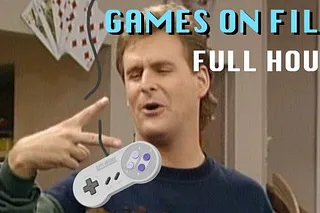
Todays system on film is…
Release: 1990 (JP, Super Famicom), 1991 (NA), 1992 (EU)
(Editor’s note: What the heck, 1992! What took them so long!?)
Plush: Super Advantage controller (1993)
Also featuring a game that doesn’t exist!?

As mentioned, when I looked at the Vectrex, Charles in Charge (GOF #9) The 80s had an influx of family sitcoms. One of the more popular ones to come out of this era, and a mainstay of ABC’s TGIF lineup, was Full House, 1987-1995. Created by Jeff Franklin.
Starring
Bob Saget/Danny Tanner
John Stamos/Jesse Katsopolis
Dave Coulier/Joey Gladstone
Candace Cameron/D.J Tanner
Jodie Sweetin/Stephanie Tanner
Mary-Kate & Ashley Olsen/Michelle Tanner
Andrea Barber/Kimmy Gibbler
Lori Loughlin/Rebecca Donaldson Katsopolis
The recently widowed Danny Tanner now looks after his three daughters with help from his brother-in-law Jesse and his best friend Joey. The three take on the role of tri-father as they raise the kids. Each week, going through the typical thrills and spills of growing up, tackling issues, but always resolving them by the end of the episode with a hug and a lesson learned. It’s schmaltzy. It’s more cheesy than a triple cheese pizza with extra cheese served to you by a cheese monger on June 4th*. That said, personally speaking, it has a certain appeal that can’t help but be enjoyed.
The three main cast members, the late Bob Saget, John Stamos and Dave Coulier, are all excellent and have great on-screen chemistry. The kids all do a fine job and tow the line between cute and annoying.
The episode
It’s a late-season episode, Stephanie’s Wild Ride S8 EP9 (First aired Nov 29th 1994). The episode was written by Adam I. Lapidus & Jeff Franklin and directed by John Tracey. The A story sees Stephanie getting involved with some reckless dickweed kid driver. D.J, who intervenes and stops her sister from getting a ride with them. Lucky, cause the speed demon totals his car off-screen, a near miss for Stephanie, and she learns a valuable lesson about trust, driving and speed safety.
But we’re not here for that. The B story has the rest of the family obsessed over a video game called Montezano’s Quest, which they “play” on their Super Nintendo.
The Scene
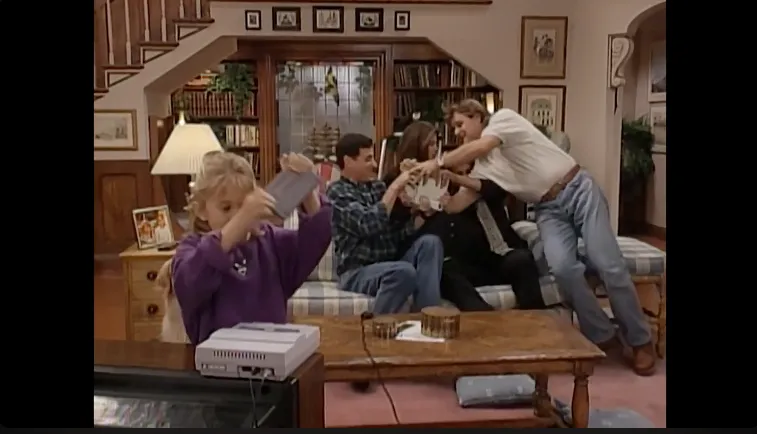
Michelle gets stuck on a level while playing her video game, Montezano’s Quest. She asks Uncle Jessie for some help beating the level, he agrees, and it isn’t long until the whole family gets roped in, to the point that they all get hooked on the game.
To stop the madness, Michelle takes matters into her own hands and takes out the game cartridge mid-game play, snapping the family back to reality, leaving Michelle to get back to her game by herself. (Comet’s attempted assistance doesn’t count; who does he think he is, Air Bud?)

Later, we get a glimpse at the game cartridge. The name Montezano’s Quest can just about be made out. The label design doesn’t match the typical layout for a NA Super Nintendo game cartridge, nor does it look like any other region’s cart label, either. Still, some further attention to detail, they could’ve left it blank or just shown it from the back. It’s not unusual for TV shows to create their own product and brands to avoid licensing issues. Though the Nintendo brand isn’t shown or mentioned, it’s very clear what everything is. The question remains what cartridge did they use for the prop? My guess would be Super Mario World, it often came with the system, and if the prop SNES was kept in its original box or if the contents were kept together, I find this fairly likely, as prop storage and handling is fairly meticulous and well looked after, so I think there is a good chance of the two being kept together.

The Super Advantage was an arcade-style joystick controller made by Asciiware. What’s most interesting about this controller is its coloured buttons that match the colours of the EU and Super Famicom controllers. The NA controller had purple and lavender buttons.
Adversely, the design of the controller somewhat resembles the design of the Super Nintendo console. The EU version of the SNES Advantage is the same, despite it not matching the EU console design (it’s all mixed up).
They “play” the game with a Super Advantage, instead of a regular controller. I feel like they used the bigger controller so it would read better on camera, with its large buttons and joystick. It also gives the actors more to tussle with when they start arguing over the game.
Are They Playing?
They don’t got it, Dude. This is a prime example of both overacting while “playing” and talking nonsensical video game babble. Apart from that, the game doesn’t even exist, so it can’t be played. So, no, they are not playing.
Why is it that even good actors fall to pieces when they pretend to play video games? I’m mostly typing generally, but realistic/good examples are few and far between, and yes, I will bring this point up again the next time it happens. (You can beat a dead horse to water, or something along those lines.)
When Jesse tries to help Michelle play the game, he controls it only using the joystick, without pushing any buttons, perhaps one of the worst examples of video game acting (at least a contender for the top 10).
What gives? There are a few games that come to mind that are controlled only by a joystick, such as Pac-Man. (That, or he was trying to start the no A button presses speed run category of Montezano’s Quest.) Though later, Jesse does use the buttons.
Joey does some classic backseat gaming, which is actually quite a nice touch. At various points of the episode, characters frantically hammer at the buttons. The SNES Advantage had a turbo function on all the buttons. Turbo basically meant that pressing the button once or pressing and holding the button would be as if the button was being pressed rapidly, e.g. rapid fire! In short, making their efforts futile.
Jesses says about putting the game on pause and returning after dinner, again just like in Mallrats (See GOF#13). Pausing a game instead of saving, had this episode come out a few years later, it might have been save your game and come to dinner instead.

What the tech?

The most likely reason could be that it’s all the props department had on hand. Plus, I think the console came with an RF cable by default, so that could explain it. It could also be that the TV just didn’t support composite. I tried looking it up, but couldn’t find the exact model of the TV. (What do you mean it’s a TV show!?)
Also, despite Danny Tanner’s best effort at parenting, he clearly never spent the time to read through the SNES instruction manual with his kids or teach proper game care. In perhaps the most violent scene ever broadcast on TV, Michelle rips the game cartridge straight out of the console without first pressing the eject button. (The button is clearly labelled, so there is no excuse.)
I suppose the real-world production reason for this was that they probably wanted something big and dramatic, and having Michelle eject and then take out the cartridge might not have had the same effect. Then again, it could have been something one of the Olsen twins just did.
To continue the idea of saving, when Michelle goes back to play the game after the rest of the family has left, does this mean she’d be starting from level one again? Did this game have a save function, and if it did, how long ago was it saved before she ripped it out of the console (how much progress was lost?) I think we can assume this game didn’t have a save system, as they paused it when they went to dinner.
What’s going on with that audio?
In the episode, the game’s audio at times surpasses what was possible on an SNES, but also uses the generic “space invaders” beeps and bloops. For instance, there are a number of voiced lines. Voices in video games, while fairly uncommon, had actually been around for quite some time at this point, mostly limited to short sound bites, often of low quality. Some examples include Sinistar (1983), Ghostbusters (Title screen, 1988) and Starfox (1993)
The opening to Super Metroid (1994) is a bit of a standout as it has several lines of spoken dialogue in its opening cut scene.
Fully voice-acted games started to become more common with the advent of games on CD, thanks to their wider storage capacity. That said, even some late cartridge games on the N64, like Perfect Dark (2000), had extensive, fully voiced cut scenes, etc.
This is a long way to say that how the game is depicted as sounding in the episode, just wasn’t possible on the base SNES. Again, this was done to better communicate to the audience what was happening in the game.
Time extension
At certain points throughout the episode, you can see that the Super Advantage is hooked up to a controller extension cable. Most consoles of this era had some variety of cable extension.
Before wireless controllers became the default, extension cables were a practical and efficient way of extending the length of a standard controller lead. Just make sure you don’t trip over them later. In the context of the episode, it also makes sense as it allows the actors more room to move around more and fight over the controller. (Did the extension cord, “extend” the comedic value of these scenes?)
Name of the Game?
What kind of game is this anyway? The way they talk about it sounds like an adventure game, almost like a point-and-click. However, most of the sound effects sound like a generic space shooter or something. Other times, it’s described more like a platformer.
Aunt Becky says, “We’ve landed on the Pond of Peace,” which to me sounds like something you’d find in an RPG like Final Fantasy or Zelda, not a platforming or shoot ’em up. The writers seem to have taken every little element they knew about video games and put it all in this one episode.
While there is no such game as Montezano’s Quest, there was a somewhat similarly titled Montezuma’s Revenge (Utopia Software, 1984). However, apart from a passing similarity in name, the gameplay doesn’t match up with the description of the game in the show. Conclusion: the two are unrelated.

A brief look at gaming and Nintendo in 1994.
A look at the kind of games the Tanners could’ve been playing. This episode aired in late November 1994. As stated in Mallrats (GOF #13), Sega launched the 32X in North America on November 21st 1994.So it’s possible someone might have had a brand new 32X sitting next to their TV when they watched this episode.
What were some of the games that came out around November when this episode first aired?
Donkey Kong Country: Nov 18th 1994 (NA), 24th Nov 1994 (EU)
At the dawn of 32-bit consoles and 3D graphics, Nintendo and Rare proved the SNES. Prerendered 3D visuals. The game was a huge success and had 2 sequels.
Demon’s Crest: Oct 21st,94 (JPN) Nov 17th,94 (NA) Dec 13th,94 (EU)
An action platformer and a spin-off series from the Ghosts ‘n Goblins games from Capcom.
Street Racer: Nov 1994
A mode 7 style racing game, notable for its 4-player multiplayer.
Over in Japan, the Sega Saturn was released on November 22nd 1994, followed by the Sony PlayStation on December 3rd 1994.
Virtua Fighter 2 hit Japanese arcades in November,94 then the EU in December 94. Then later in Jan 1995 in North America.
Bob Saget (May 17, 1956 – Jan 9, 2022)
I would be remiss if I didn’t take a moment to mention the late Bob Saget.
He managed to carve out two distinctive careers, almost like a Jekyll and Hyde. A late-night stand-up comedian, capable of the most wickedly dark jokes and within family entertainment, as the dorky Dad on Full House, but as the host and commentator of America’s Funniest Home Videos. From 1989 to 1997. Saget would also reprise his role of Danny Tanner in Fuller House (2016-2020).
Saget directed the cult comedy classic Dirty Work (1998), starring Norm Macdonald and Artie Lange. Along with a host of comedic cameos, including Don Rickles.
Later, his podcast Bob Saget’s here for you. Showed yet another side of Saget outside of his stage persona. Featuring some really interesting and heartfelt interviews and nice personal interactions with his fans.
I also recommend seeking out his book Dirty Daddy. Not only is it hilariously funny, but it also offers up some interesting insights into the world of comedy, and a Deep, insightful look into Saget’s own life.
How Bob Saget is remembered will be different for everyone. Perhaps you only knew him as the Dad from Full House, or maybe as the foul-mouthed comedian, or the narrator on How I Met Your Mother. or maybe it’s a combo of all his works, either way, Bob Saget created one heck of a legacy, that was ended way too soon, but one that can still be remembered, shared and enjoyed.
Well, there you have it, another over-analysed thing for the books.
*June 4th is one of several National Cheese Days..