Todays game on film is...
Game: NHL ALL-STAR HOCKEY Developer:Gray Matter Inc. Publisher: Sega System: SEGA SATURN Release Date: 1995
Also Featuring: Sega Genesis and NHL 94

The film at a glance
Mallrats (1995), written and directed by Kevin Smith. Starring Shannen Doherty (Rene Mosier), Jeremy London (T.S. Quint), Jason Lee (Brodie Bruce), and Claire Forlani as Brandi Svenning. Also featuring Michael Rooker (Jared Svenning), Joey Lauren Adams (Gwen Turner), Ethan Suplee (Willam), Brian O’Halloran (Gill Hicks), and a cameo by Stan Lee.
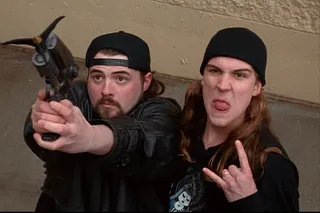
Jason Mewes and Kevin Smith reprise their roles as the duo Jay & Silent Bob, who first appeared in Clerks (1994) and have since made appearances in most of Kevin Smith’s films (at least within the View Askewniverse).
Although the film now has a cult following, at the time, it wasn’t as well-received by critics, who no doubt had hoped for more from the director of the indie darling Clerks. The plot centres around two recently dumped “slackers” hang out at the Mall, get into misadventures, and plot how to win back their respective exes. What follows is a string of jokes, pratfalls, and the pair evading the Mall security, eventually ending in taking part in a dating game-style game show,before everything is tied up with a Hollywood ending.
The film offers up some interesting social commentary, memorable jokes, and Jay and Silent Bob are always a highlight. Mallrats has its moments, but is neither as strong nor as visually interesting as Clerks or Smith’s following films, Chasing Amy and Dogma, both of which were also better received.
To be fair, this was only Smith’s second feature and first studio film, so I think some slack can be cut. Also, knowing that the film was kind of screwed in editing, leading to a film that seemed to be Frankensteined together just to get it to 94 minutes. The result is that the plot points don’t follow through, and it feels like something is missing, and it is. The botched editing is further butchered with the TV edit.
The scene
Brodie wakes up and almost immediately continues his game, which he’d kept on pause (presumably) from the night before. Much to the annoyance of his girlfriend, Rene, who wants him to make her breakfast. (Couldn’t he just keep his game paused a little longer? Well, I guess that’s the point of the film or something, right?)
Rene
What are you doing? You promised me breakfast.
Brodie
Breakfast, shmreakfast. Look at the score, for Christ’s sake. It’s only the second period, and I’m up 12 to 2. Breakfasts come and go, Rene, but Hartford, “the Whale,” they only beat Vancouver once, maybe twice in a lifetime.


Brodie is holding a standard Genesis controller; beside him on a bedside table is a Sega Genesis (Possibly model 2), which is somehow hooked to a TV that’s at the foot of his bed. (I suppose extension cables and the like do exist.) There is good attention to detail in that the game’s score matches his lines. Later, Brodie has another Sega related line.
“Hell hath no fury like a woman’s scorn for Sega.”
Originally, the game he was supposed to be playing was NHL ’94 on the Sega Genesis. (This can be seen in a deleted scene.)

PAUSE for thought
Brodie leaving his game on pause to “save” his progress is an interesting detail. Back in the day, the ability to save a game’s progress still hadn’t been standardised, with most games either using a battery backup to save game data or a password system. If a game didn’t offer a way to save progress, players weren’t left with many options: either take the loss and turn the system off, start all over again, or leave the console ON and pause the game.
The Neo Geo AES was one of, if not the first, home consoles to use a memory card. The Sega Saturn had a cartridge-style memory card. The N64 also had a memory card that plugged into the back of the controller. The style of Sony PlayStation’s memory cards more or less became the de facto blueprint for memory cards for a while, such as GameCube, PS2, and Xbox. The Sega Dreamcast, however, had a very unique memory card, but I’ll have a lot more to say about the Dreamcast in a future GOF, so watch out…
End…
This GOF illustrates how product placement and deals can significantly impact a film’s production. In this case, I don’t think too much was changed and affected, but some films perhaps go too far with the product placement and can end up feeling more like a commercial awkwardly inserted into the middle of a film.
The mid-90s were also a turning point for video games, where it was clear 3D was the future, evidenced perfectly in Mallrats, where the “old” 2D graphics of the Sega Genesis were replaced by the NEW shiny 3D 32-bit graphics of the Saturn.
I’ve seen the majority of Kevin Smith’s films (still need to see some of his newer stuff), but can’t offhand remember any more specific instances of video games in his films. It’s a good excuse to do a re-watch of his catalogue to find out.
Thanks to the following resources that helped with the research for this blog.
segaretro.org
wikipedia.org
Nintendo.Fandom
Mallrats: Gramercy Pictures, View Askew Productions, Alphaville Films.